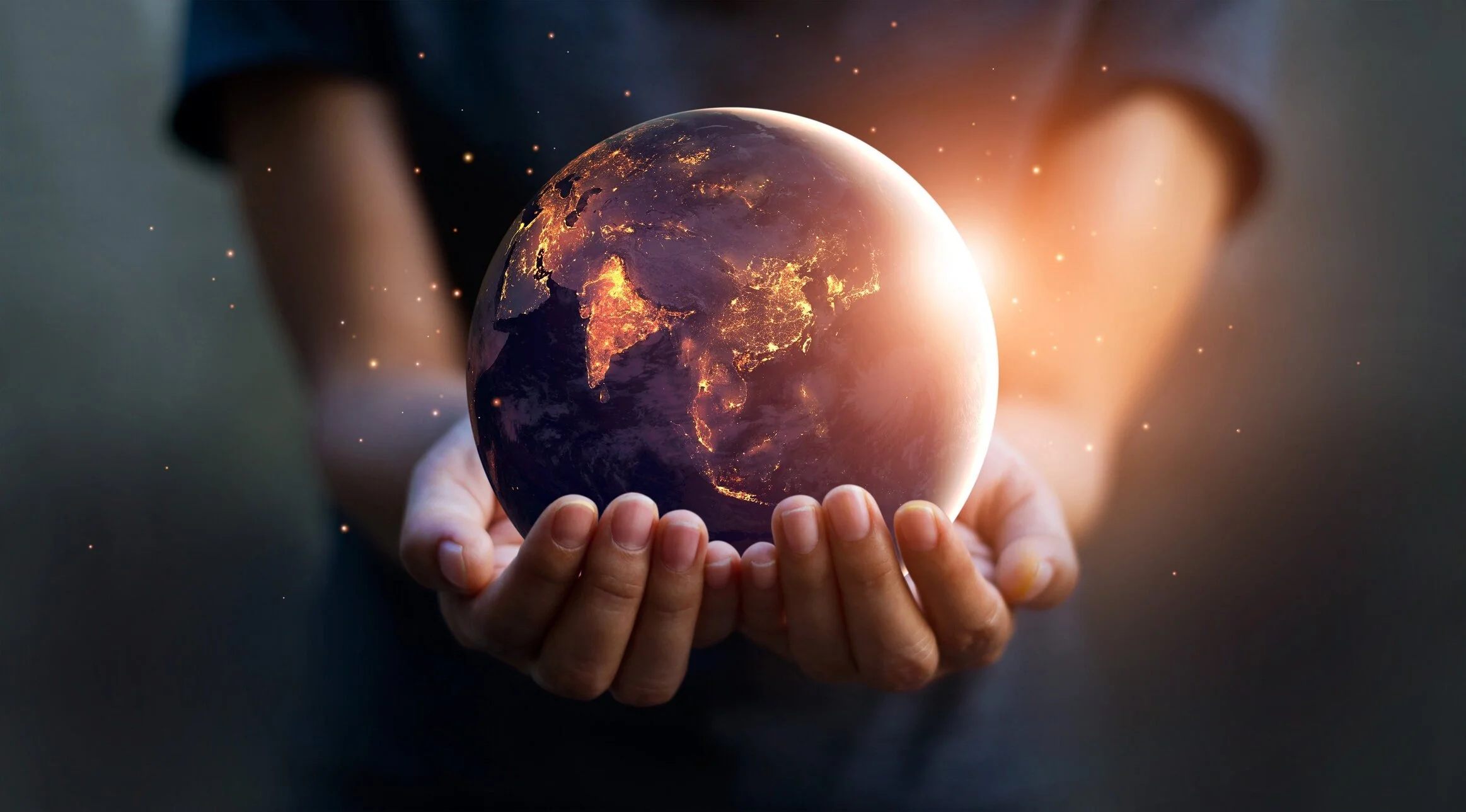
Everything I need to thrive on a daily basis has come from this planet.  But I know I can’t take all of this for granted.  It gives so much to support me and I know as with all good relationships, there is a balance between give and take. That is why I love this quote from John Denver; “Love the Earth as you would love yourself.”  Without the earth, I couldn’t live the life I do.  

I wake up and the sun coming through my window gives me light and warmth and gives the food I buy the energy to grow.  Not to mention the countless variety of foods that grow on earth giving me so many choices as to what I want to eat.  I listen to the radio that runs on electricity created by earth’s resources.  I have water to drink and use to take showers.  The clothes on my back are sourced from materials made from plants.  The oxygen I breathe comes from forests and the oceans. What more could I ask for?  

We are spinning on this giant blue ball in the middle of Milky Way Galaxy.  Gravity naturally holds us down onto the earth as we go about our days.  This is the only known planet that has the best living conditions for humans.  We have been given so much to thrive on this planet.  

But how can I show my appreciation for the earth for all that it does for me?

Maybe I can’t solve the plastic pollution crisis but I can choose to use reusable bags when I go to the store.  Maybe I can’t stop commercial farming to stop using pesticides that are killing bees, but I can plant bee friendly flowers in my garden.  Maybe I can’t stop forests from being cut down for paper goods but I can buy eco-friendly products and recycle.   

These are just a few ways I can help support this planet that is always supporting me.  If you have more ideas on how we can support the earth, please share!


Giraffe Conservation Foundation are helping to save this iconic species from extinction

When I think of an African safari, I think of wanting to see wildlife such as giraffe.  Giraffe are gentle friendly animals who are similar to elephants in that they exhibit emotional traits like grieving the loss of another and live in herds.  

Giraffe also contribute to the ecosystem more than we may realize.  According to Sheldrick Wildlife Trust, giraffe help to keep ecosystems in balance.  Because of their height, giraffe forage on taller plants and trees which in turn promotes plant growth and allows other wildlife feed on the lower plant life.  

The unfortunate reality is giraffe are facing a silent extinction process. The giraffe are a viable part of the ecosystem and if they were to become extinct, other wildlife would suffer as well. 

Recently I attended a workshop given by the Giraffe Conservation Foundation (GCF).   I learned there are four species of giraffe and three of these species are in trouble.  The total giraffe population has decreased 30% in the last three decades and in places like Mali and Nigeria, the giraffe have gone extinct.  90% of their habitat has been lost to urban development and have mostly become fragmented.  Other factors that are contributing to their decline is climate change and poaching.  

Per the Convention on International Trade in Endangered Species of Wild Fauna and Flora (CITES), their status is listed under Appendix II which means the giraffe is not necessarily threatened with extinction.  As their habitats and lives become increasingly threatened, it would be my hope they would receive more protection and become listed under Appendix I as a species threatened with extinction.  

Currently, GCF is collaborating with governments such as Niger, Kenya, Tanzania, Democratic Republic of Congo, and Uganda to create strategies to ensure survival of the giraffe population in these countries.  This is critical as it was emphasized most of the public who live in regions where giraffe cohabitate, do not realize the threats that giraffe face.  

In Murchison Falls National Park in Uganda, GCF has been removing snares intended to trap animals by poachers in order to help save the giraffe population.  They also scout for giraffe or other animals hurt by snares in order to remove the snare.  Over the past couple of years, GCF has been able to save 189 giraffe and removed 649 active snares intended to trap animals.  

GCF have developed satellite technology to follow giraffe herds and understand what plant life they feed from.  GCF has also begun mounting GPS tracking on giraffe ossicone (the paired weapons on the top of their head) to help know where the giraffe are, what corridors the giraffe use in order to protect and conserve these areas for giraffe to migrate safely, and to learn why giraffe will cross a geofence into another region.  

Giraffe Conservation Foundation is trailblazing a path to help protect the giraffe population and ensure its survival.  If you would like to learn more about their work, donate, or adopt a giraffe, please click here.  

If you love giraffe, please share this blog post and let others know the giraffe population needs help!  Nature already does so much for us, we can help look after it!

References: 

1. https://www.sheldrickwildlifetrust.org/about/species-we-protect-giraffe

2. https://giraffeconservation.org


Love is Love


Love is a universal expression we all have in common with each other.  It’s what binds us together, gives us purpose, and builds communities.  Being that love is universal, it is also experienced within the animal kingdom and between humans and animals.  

A mother elephant will demonstrate gentle tenderness and love to her baby calf just like a human mother would.  A mother bear will protect her cubs with all the ferocity and strength without fear of her own life just as a human mother.  

My heart can swell up with love seeing an old friend or seeing an elephant calf surrounded and being taken care of by its herd.  Love doesn’t decide who you love or share it with.   

Love is the language we all speak and share among all species.  Every being on this planet is an expression and deserving of love.

The photo above is of my babes; Waggs and Diva.  They have taught me so much about what love really means when you live from your heart. 

“The love for all living creatures is the most notable attribute of man.” Charles Darwin

With Love,

Nicole @WildForChange 

Foxes, minks, and chinchillas need their coats more than we do.

Did you know 100 animals can be killed to make one coat?

100 million animals are killed for their fur each year.  85% of these animals come from factory fur farms and the rest are trapped in the wild.  Animals like minks, chinchillas, raccoon dogs, and foxes are found on factory fur farms.  These animals are wild but live their lives in battery cages, unable to live life expressing their natural behaviors causing high amounts of unnecessary stress for these animals and fear towards humans.  

These animals understandably develop an array of health disorders ranging from infections, self-mutilation, missing limbs from biting incidents, and open wounds.  In order to maintain the pelt of an animal, they are either electrocuted, bludgeoned, skinned alive, or gassed all for the price of fashion.  

Not only are animals raised on fur farms treated inhumanely, there are risks of disease spread from the animals to humans.  According to Born Free U.S.A., minks on fur farms in Utah and Wisconsin have tested positive for SARS-CoV-2 virus – the virus that causes COVID-19 in humans.

Around the globe, many countries have begun enacting legislation or phase out fur farming. Some of these countries are the U.K. (2000), Czech Republic (2019), Netherlands (2023), Norway (2025), Japan (2016), and New Zealand (2013).  If you want to learn more about fur farming bans, Fur Free Alliance has great information.  

In 2010, the United States created the Truth in Fur Labeling Act which closed a loophole that allowed real fur to go unlabeled if the value of the garment was less than $150. Unfortunately, the United States has not implemented a ban of fur farms.  There are approximately 400 fur farms in the U.S. and these farms are the only sector of animal agriculture without federal regulation on how the animals are cared for, housed, or killed.

In 2019, California became the first state to ban the sale of fur which can hopefully create an initiative in other states to do the same.  

Fortunately, many designer brands like Gucci, Coach, Michael Kors, Giorgio Armani, Stella McCartney, and Tommy Hilfiger have committed to stop selling fur fashion.  Prada has also pledged to go fur-free with its 2020 spring and summer collection after the Humane Society launched a campaign to urge Prada to stop selling fur. 

Companies like Macy’s and Bloomingdales will stop selling fur as of February 2021. 

The choice is ours to help end this cruelty.  We can turn the tide and make fur farms a thing of the past.  

Ways we can help end cruelty to fur farm animals:

·      You can also help stop fur farming in the United States by signing this petition.  

·      This petition that calls the United Nations to ban all fur farming.  

 ·      I am seeing new clothing companies coming into vogue with cruelty free fashion.  Companies like Noize are making winter coats that are warm, functional, fun and most importantly, cruelty-free!

·      If you would like to learn more about ways to support humane shopping and stop exploiting animals for fashion, click on the link below;

https://www.humanesociety.org/resources/humane-shopping-guide

References:

https://www.humanesociety.org/all-our-fights/going-fur-free

 https://www.humanesociety.org/news/macys-inc-commits-going-fur-free

http://vegetarianstar.com/2010/12/21/obama-signs-truth-in-fur-labeling-ac/

https://www.furfreealliance.com/fur-farming/

https://www.bornfreeusa.org/campaigns/fur-trade/silentsuffering/

COVID’s Impact on Wildlife and Nature

Initially when the world was on lockdown, I was hoping it would give wildlife and nature a reprieve from human activity.  We are all competing for Earth’s resources and space and I thought a pause in human activity or as scientists are terming ‘anthropause’ would give wildlife and nature a chance to recalibrate. 

I read dolphins had returned to Venice canals and there was less stress on marine life such as humpback whales because there was a decrease in noisy boating activity.  

A study in Florida demonstrated that generally loggerhead turtles will lay eggs 50% of the time when coming to shore.  During the pandemic, the research showed the rate increased to 61%.   

This lockdown has also prompted large scale studies such as from the International Bio-Logging Society have been researching how reduced human activity via vehicle, ship, and aircraft traffic is affecting animal behavior.  The results of these studies will have heft as to determine how detrimental our activity affects the natural world.  

Later I learned from colleagues who were on the front lines of fighting wildlife traffickers, there hasn’t been a reprieve for some wildlife.  As people cannot find work in rural areas, wildlife poaching has been an avenue of generating income for some just to put food on the table.  

“What we’re seeing is an incredible impact on nature because millions of people are suddenly unemployed and they have nothing to fall back on,” says Joseph Walston, head of global conservation at the Wildlife Conservation Society in New York City. “In places like South-east Asia, there’s this huge urban-to-rural migration where people have lost their jobs in the cities overnight. They’re now having to depend on poaching, logging or other activities that are degrading nature because they have no other option.”

Even wildlife who live in conservation parks, such as rhinos are at risk for poaching since ranger patrols have been reduced due to COVID.  This gives poachers an easier shot of hunting wildlife.  

Michael O’Brien Oneyka, Vice President of the Africa Field Division for Conservation International states, short-term dispensing of food is an option but long-term it would be beneficial to generate alternate income-streams for people living in these areas other than ecotourism, in which many people rely on for income.

One initiative that is making a positive impact for local communities and the environment in these uncertain times is called the REDD+ implementation (Reducing Emissions from Deforestation and Forest Degradation).  For example, the Chyulu Hills REDD+ program in Kenya is helping local people and the environment during this time where income and reducing our carbon footprint are important.  It is comprised of a coalition of partners which includes two government agencies, three local NGO’s (Non-Governmental Organization), and four members of the Maasai community that will compensate the local communities with carbon credits by preserving forest areas instead of destroying these areas by agricultural encroachment or the practice of charcoal burning.  These carbon credits can then be used as an alternative for providing an income and sustaining the surrounding environment.  

This strategy can be very effective in maintaining and sustaining ecosystems and biodiversity thereby supporting wildlife, as well as supplying a means for income for people even when there is uncertainty in the world and global economy. 

The pandemic has brought about a mixed bag of positive and negative consequences on wildlife and nature.  But this global situation has also been able to shed light on the effects of human activity on wildlife and nature.  This will give scientists a surge of data to research and study which can shed light on how we can reduce our impact and improve our connection with the natural world in the future.  

References:

1.    https://www.nature.com/articles/s41559-020-1237-z

2.   https://www.sciencemag.org/news/2020/08/pandemic-stilled-human-activity-what-did-anthropause-mean-wildlife

3.   https://www.bbc.com/future/article/20200520-the-link-between-animals-and-covid-19

4.   https://www.conservation.org/blog/in-kenyas-storied-hills-traditional-ways-confront-a-modern-problem-climate-change/

5.    https://redd.unfccc.int/fact-sheets.html

COVID-19’s Impact on the Environment

When COVID-19 hit and I read people were working from home and traveling had taken a backseat, I thought the environment was getting a break from our daily lives.  I saw video footage of dolphins returning to swim in the Venice canals, smog that was a way of life in densely populated cities in countries like India and China was gone and skies were clear and blue. It seemed amazing to me how fast nature went back to the way it used to be. I was hoping this new way of living would set the stage for countries around the world to notice and take positive action on reducing our carbon footprint.  

However, many months into this pandemic and countries are making up for lost time.  It looks like we have reverted back and causing more harm than usual on the environment.  

According to National Geographic, China is now giving the go ahead to create more coal fired plants.  Allowing dirty fuel to be released into the air, instead of finding ways to use improved clean energy to run plants.  

The U.S. government is no different and is allowing big rollbacks on environmental restrictions for oil and gas.  The Trump administration has also restricted enforcement of air and pollution regulations. 

President Bolsonaro of Argentina has allowed increased logging of the Amazon rainforest in the midst of a pandemic that is affecting people’s ability to breathe.  Rainforests are being cut down at an astronomical rate.  According to the National Institute for Space Research (INPE), satellite data showed 64% more land was cleared in the Amazon in April of 202o than the previous year.  

Not only have we lost footing on the initial progress made to give the environment a break, another major problem has developed; plastic pollution.  As lockdowns occurred globally, the value of petroleum plummeted which means the cost of making virgin plastic is now less expensive than recycling plastic.  In addition, the use of personal protective equipment skyrocketed with single-use face masks causing a massive increase in plastic pollution.  

In February of this year, the production of single-use face masks increased to 116 billion per day in China.  If the global population adheres to single use face masks, by the end of pandemic, the global monthly consumption would result in 129 billion face masks and 65 billion gloves.  Currently, we do not have the means to recycle this amount of plastic.  Improper disposal of just 1% of face masks, accounts for 10 million items ending up in waterways and beaches globally.  

The plastic pollution that ends up in waterways is affecting the wildlife that live in these areas.  According to Laura Foster, the head of Marine Conservation Society states that the disposable face masks are ending up in areas where wildlife can get tangled in them or end up digesting them, causing a big risk of microplastics harming wildlife.   

Luckily, there are companies and scientists noticing these effects and are working towards solutions.   According to The Conversation, there are many alternatives and technologies that are being tested and implemented at this time to help reduce the use of personal protective equipment;

·      The critical care decontamination system. This is a container made by a company in Ohio which can decontaminate up to 80,000 items of PPE at a single time.

·      Scientists at the University of Nebraska are researching whether ultraviolet light can decontaminate masks and respirators.

·      Biodegradable gloves are available, which can decompose in landfill in two years

Here are some ways we can help reduce our need for single use plastic during this pandemic; 

·      Avoid single use water bottles and purchase a reusable water bottle.

·      Purchase a bamboo or metal straw.

·      Ask the owners of restaurants you go to if they have alternatives to plastic packaging. 

·      During this pandemic, purchase a reusable face mask.  Here is a link to 18 face masks that support good causes;

https://www.cnn.com/2020/06/16/cnn-underscored/face-masks-that-give-back/index.html

·      Contact your local legislator about banning single use plastics.  You can find your state and federal legislators here.

·      Let companies that make your favorite things know you care about how they package their goods by tweeting, calling, or writing a letter to them asking for more sustainable, biodegradable, recyclable packaging.    

As we live and find our way through this pandemic, we can come out on the other side knowing we are all in this together and make choices that will positively affect you, me, the world, and the environment.  


References:

https://www.nationalgeographic.com/science/2020/06/why-covid-19-will-end-up-harming-the-environment/

https://science.sciencemag.org/content/369/6509/1314

https://www.bbc.com/news/uk-politics-54057799

https://theconversation.com/healthcare-is-still-hooked-on-single-use-plastic-ppe-but-there-are-more-sustainable-options-143940

https://www.nrdc.org/stories/single-use-plastics-101#avoid


Defend America’s Climate Control Tongass National Forest – Keep It Roadless

Tongass National Forest, located in the southeastern region of Alaska spans over 500 miles and boasts the largest intact temperate rainforest in the world.  It is also the largest national forest in the United States.  Alaska natives have lived in this area for 10,000 years along-side bear, wolves, eagles, whales, and salmon.  

In 2001, the National Roadless Area Conservation Rule was adopted to protect and preserve large undisturbed areas for intact habitats of wildlife, contribute to healthy watersheds, clean drinking water, and tourism.  This rule was to provide protection for the Tongass National Forest and the Chugach National Forest in Alaska.  

Now the Tongass National Forest is being opened by the Trump administration for logging and development.  To go into this vast wilderness for logging is incomprehensible.  It will not only disrupt native people living in this region, ecosystems, wildlife, and the viability of tourism, it is also one of the world’s largest carbon sequesters.  Logging will allow large amounts of greenhouse gas emissions to be released, affecting our climate.  Logging accounts for a mere 1 percent of jobs in southeastern Alaska.   This is in direct opposition to the $1 billion dollars that tourism brings into the region EACH YEAR!

To defend Tongass National Forest from logging and development, please sign the petition in the link below telling Congress to protect this region and keep it roadless!!!!

https://earthjustice.org/features/tongass-old-growth-climate-change

With gratitude,

Nicole @WildForChange 

Resources:

1.    https://www.fs.usda.gov/main/tongass/about-forest

2.   https://www.wilderness.org/articles/blog/3-reasons-ramped-logging-our-biggest-national-forest-could-be-disaster

3.   https://www.npr.org/2020/09/25/916932812/trump-administration-moves-to-allow-logging-in-alaskas-tongass-national-forest

4.   https://earthjustice.org/features/tongass-old-growth-climate-change

How Land Clearing Is Affecting Our Lives More Than We Realize

I remember when I first moved into my neighborhood, there were multiple small areas of land that looked like mini forests.  I would drive by these areas and awe in their beauty during the fall when the leaves were changing and watch the birds make their nests in the trees.  There was something tranquil just even driving past these areas.  Now some of those mini forests have been replaced with large strip malls with multiple stores and fast food eateries.  It feels like I was somehow transported from rural living to urban living.  

Clearing land has a big effect on natural habitats.  When land is cleared for human use, it destroys ecosystems and habitats for wildlife.  Loss of indigenous habitat for wildlife can lead to their extinction as they have no other place to live and thrive.  On a large global scale, examples of this are areas of once extensive wild habitats for elephants are now fragmented because of human settlements, loss of habitats for orangutans to produce palm oil plantations, and deforestation of Amazon rainforests for cattle ranching accounts for 80% of global deforestation.  Deforestation has become so rampant, it has been estimated that every second an entire football field of forest is gone.  

Not only does land clearing effect the natural habitat of wildlife, as humans continue to move further into these natural areas and come into contact with wildlife, there is an increased risk of humans becoming infected with viruses just like COVID-19.  Scientists estimate there are 1.7 million viruses found in mammals and birds that can infect humans.  This is especially linked to deforestation as there is a rich biodiversity found in forests which has more opportunities for such viruses to be contracted by humans who are logging and cattle ranching in these areas.  Even the cattle coming into contact with wildlife could also become carriers of viruses and pass them on to humans handling them. 

Land clearing and development also causes a loss of the indigenous plant and tree life which has a huge effect on the health of the planet for many reasons. When native plant and tree life are removed, soil erosion occurs causing a loss of nutrients that would allow for plants to grow that give us oxygen.  Loss of plant life also causes ground water levels rise because there is no longer plant roots to absorb the water.  Additionally, when native trees and plants are removed from their natural habitat, the carbon dioxide that was sequestered in the ground is now released into the earth’s atmosphere which has been found to alter our climate.   

Land clearing also has an effect leading to increased urban temperatures.  When habitats are removed and replaced with buildings and pavement, the roofing and pavement materials tend to absorb rather than reflect the heat of the sun.  This is known as urban island effect.  

Making wiser daily choices in our lives can make a huge impact on where we are headed ecologically.  Small steps can make big improvements to keep us and our planet healthy.  

Ways we can make an impact to help the environment:

1.   Know that every product made from trees is recyclable.

2.   Buy recycled paper products.

3.   Avoid buying products made with palm oil.

4.   Reducing the amount of red meat one eats helps to reduce deforestation, reduce CO2 emissions, and saves animals. 

5.    Plant a tree.

6.   Buy wood products that have the Forest Stewardship Council mark. 


References:

https://www.epa.gov/report-environment/land-use

https://urbanization.yale.edu/research/theme-4

https://www.everythingconnects.org/urban-sprawl.html

https://sciencing.com/effects-of-land-clearing-13406919.html

https://www.theworldcounts.com/stories/how-can-we-stop-deforestation

https://www.nationalgeographic.com/environment/2020/10/protecting-land-animals-will-mitigate-future-pandemics-report-says/


Let's Stand Tall For Giraffes

If you picture a giraffe, what comes to mind?  Can you picture the gracefulness of their gallop, gently reaching for leaves up high on trees, caring and nurturing their young?  Giraffes are known as the ‘Gentle Giants’.  They do not pose a threat to any other species but poachers and trophy hunters pose a threat on their very existence.

According to the African Wildlife Foundation, in the past 30 years, the giraffe population has plummeted by 40%.  Yes, you read that correctly.  These Gentle Giants are being sought after for their hide for pillows and bible covers.  Their meat is being sold in markets as beef.  Their bones are believed to have cures for human illnesses.  They are being pushed out of their habitats for human development. 

To add to this sobering reality, The Humane Society of the United States reported between 2006-2015, 40,000 giraffe products were imported into the United States!  That is unimaginable to think giraffes are being hunted to be someone’s decorative pillow or cover for a book.  Because of their unfortunate demise, recently, two giraffe sub-species were categorized as critically endangered.  

Please join me to stand tall for the giraffes and add your name here in alliance with the African Wildlife Foundation to step up and protect these innocent and precious beings.  


With gratitude,

Nicole @WildForChange

Throwing Out the Trash

The average American throws out 4.5 pounds of trash per day, that is the weight of roughly a modest sized pumpkin.  Across the United States that amounts to 728,000 tons of trash thrown out daily.  Trash being “thrown” out, never really goes away.  It just gets picked up by a waste management company and heads over to a landfill.  Since most of the trash that is “thrown” out is not biodegradable, the trash just sits in these landfills posing problems to our air, water, and land. 

Even though landfills are a form of waste management, besides recycling, composting, and incineration, there are many downsides to landfills.  The trash in landfills release gases like carbon dioxide and methane into the air which continues to trap heat in our atmosphere.  Methane gas is more problematic because it is up to 20 times more effective at trapping heat than caron dioxide.  Landfills also release liquids, one being leachate which contaminates underground water sources.  The EPA requires that this liquid is captured and disposed of using leachate pumps.  There are a number of closed or abandoned landfills that still emit leachate into our water. 

Because of the amount of trash thrown out daily across the United States, large amounts of space is needed to build a landfill.  When a landfill has reached its capacity, the options are to either make the landfill bigger or build more.  When a landfill can no longer be filled or made bigger, the waste is “capped” by a layer of land built over it.  

Through the Resource Conservation and Recovery Act, the federal government has mandated each capped landfill must be monitored and maintained for 30 years after it has become inactive.   Fortunately, there have been innovative ideas for the capped landfills such as using the land for solar and wind energy projects, parks, and creating wildlife habitats.  

Although, these new uses for capped landfills have benefits, it does not address the amount of garbage ending up in landfills, which most of the garbage is plastic that does not biodegrade such as plastic bottles.  Landfill production will continue to grow if we do not actively work on solutions to minimize our trash impact. 

Here are a few ideas to minimize your impact on trash:

1.    Bring reusable shopping bags and containers when going to the store.

Say goodbye to plastic storage bags with these reusable pouches by 4Ocean:

https://www.4ocean.com/products/4ocean-x-stasher-reusable-storage-bag

2.   Buy in bulk to reduce packaging.

3.   Stop your junk mail!  We receive about 30 pounds of junk mail per year!

4.   Compost your food scraps whenever possible.  

5.    Instead of buying bottled water or ordering a single use disposable coffee cup, buy a reusable tumbler for your water or coffee.  

These small and impactful ideas when multiplied can become helpful and preventative ways we minimize our trash impact.  


References:

1.    https://www.hazardouswasteexperts.com/landfills-an-unsustainable-form-of-waste-management/

2.   https://www.saveonenergy.com/land-of-waste/

3.   https://www.dumpsters.com/blog/what-happens-when-a-landfill-is-full


What's All the Buzz About?

Before you take a sip of your almond milk or a bite out of your apple, you may want to thank a bee for it.  One in three bites of the food we eat is due to bees pollinating plants.

Bees are important for a number of reasons; they help maintain healthy ecosystems and they provide food for animals and humans through pollination.  These pollinators help to fertilize plants which results in the formation of new seed growth, which produces more food for us to eat. 

Save on Energy estimates bees pollinate 1/3 of the food we eat ranging from fruits, vegetables, grains, nuts, and seeds.  According to the HoneyBee Conservancy, without bees, we would lose 100% of almond crops, 90% of apples, blueberries, and cucumbers to name a few.  Bees contribute to approximately $15 billion of U.S. crop production per year.  

But each year, bees are dying off.  Between 2015-2016, 44% of beekeeper colonies died.  In 2017, bees were placed on the endangered species list.  

Not only are bees providing us with food and maintaining a healthy ecosystem, they are also helping reduce human-elephant conflict in Kenya, Africa.  Elephants are known to be afraid of bees which lead Save The Elephants to develop “Elephant and Bees Project that helps farmers reduce elephant crop raids by placing beehives around the crops as a deterrent.  This is a major win in all directions to help the farmers grow and sell their crops successfully, bees help pollinate crops, and elephant-human interaction is reduced.  

We really do need the bees but the bees really do need our help!

One young girl, Mikaila from Austin, Texas is stepping up for the bees. When she was just four years old, within a week, she got stung twice by a bee.  She decided to learn more about what bees do and learned how important bees are to our food production.  Mikaila had an idea to begin selling lemonade (her Great-Granny’s recipe) and “Me and the Bees” was born using honey instead of sugar for sweetener.  Now her lemonade is sold in places like Whole Foods and World Market. Mikaila started a foundation to help save the bees through research, education, and protection.  To learn how she is helping the bees, click here.

There are also a number of ways we can help bees from creating a garden or homes for them.  To learn more, you can find tips here.

Each one of us has a unique reason and purpose for being here and we are all inter-connected.  Recognizing this is the first step which helps us see the magic and beauty that surrounds us.    

References:        

1.    https://www.saveonenergy.com/honeybees-become-extinct/

2.   https://thehoneybeeconservancy.org/how-to-save-the-bees/

3.   https://ento.psu.edu/pollinators/resources-and-outreach/what-are-pollinators-and-why-do-we-need-them

4.   https://elephantsandbees.com

5.    https://www.meandthebees.com/pages/about-us

The Benefit of a Shark’s Existence Vastly Outweighs the Price of a Bowl of Shark Fin Soup.

The Benefit of a Shark’s Existence Vastly Outweighs the Price of a Bowl of Shark Fin Soup.

Many people have seen the movie Jaws where a Great White Shark is terrorizing people off the shore of a New England tourist town. Sharks instill fear in many since some people have been bit or killed by a shark while surfing or diving.

According to the Florida Museum of Natural History, globally there are approximately 82 unprovoked shark attacks resulting in four human fatalities annually.

Happy World Elephant Day

This pandemic has made me stop and reflect what is important to me.  

Nature is one aspect of my life that I find important.  When I look deeper into nature, I see how everything is connected.  Elephants are a part of this connection that actually make our world a better place.  

Elephants are a keystone species in which other species and the ecosystem largely depend and are known as the Gardeners of the Forest.  When eating from grasses and trees, elephants spread seeds around they have eaten which helps plant life to grow other areas.  This new plant life gives off oxygen for us to breathe.  

Elephants also dig waterholes in dry river beds that other animals use as a water source as well as creating trails that serve as fire breakers and water run offs.

Without their presence, the ecosystem, other wildlife, and ourselves would be at a loss.  Despite elephants being killed for their ivory to be sold as trinkets or statues, we cannot put a price on how valuable their lives are to this planet.  

Today, I celebrate the importance of an elephant’s presence on this planet and how my life is richer because of it. 

“Animals should not require our permission to live on earth.  Animals were given the right to be here long before we arrived.”

Anthony Douglas Williams

Happy World Elephant Day

Nicole @WildForChange

Whales – What Does Poop Got To Do With It?

I love whales.  They are majestic and mysterious creatures that are similar to humans in so many ways.  Whales are highly intelligent who form friendships, protective of their young, are known to be playful, and also grieve the loss of another.  They are able to communicate with each other and their calls can be heard for miles underwater.   

Beyond these amazing characteristics, whales play an important role in our ecosystem.  Whales help provide the oxygen we need and help combat climate change.  How do they do this?   They provide nutrients to phytoplankton.  

Phytoplankton can be compared to plants that live on the ocean’s surface that require sunlight, water, nutrients like iron, and carbon dioxide to photosynthesize.  In short, phytoplankton sequester carbon dioxide from the earth’s atmosphere.  

Whales come near the surface of the oceans to defecate and when they do, they help to fertilize the phytoplankton which keeps the phytoplankton healthy and continue like plants on land to absorb the carbon dioxide in the air and provide part of the oxygen we breathe.  Whales are like the gardeners of the ocean and help provide us with 50-80% of the oxygen we breathe.  

Which is why it is so important to help keep our oceans healthy.  An easy way to help keep our oceans and marine life healthy is to purchase a bracelet from 4Ocean.  For every purchase of a bracelet, a pound of plastic is removed from the oceans.  

Here is a link to purchase a whale bracelet:

https://www.4ocean.com/collections/bracelets/products/whale-braided-bracelet

A little help can go a long way to keep our oceans healthy and us!

References:

1.    https://us.whales.org/whales-dolphins/facts-about-whales/

2.   https://us.whales.org/green-whale/

3.   https://oceanservice.noaa.gov/facts/ocean-oxygen.html

4.   https://www.4ocean.com

What Do You Know About Palm Oil?

I have been avoiding buying products that contain palm oil because I knew rainforests were being destroyed to create palm oil plantations.  But I never realized just how devastating the effects of these plantations are affecting our environment, wildlife, and people living in areas where plantations are being built until I saw this video: 

http://orangutanvideo.littlethings.com/

This video motivated me to learn more about palm oil’s production and consumption and it’s rippling worldwide affects. 

Palm oil is derived from the fruit of oil palms.  In order for palm trees to grow, they need warm temperatures, sunshine and a lot of rain.  Palm oil is mostly derived from Asia, Africa, and South America. Once palm trees are planted, they can produce fruit for more than 30 years which can yield a high amount of oil (1).

Palm oil is the cheapest vegetable oil to produce and refine.  The properties of palm oil are used in a variety of products such as food like ice cream, chocolate, pizza dough.  It is also found in cosmetics, detergents, shampoo, and candles (2).  It is estimated that 50% of consumer goods are derived from palm oil (2).   Most pre-packaged snack foods from companies like Nestle and Unilever contain palm oil.  Therefore the production of palm oil is highly lucrative and highly sought after by many manufacturers.

But what is all the negative buzz surrounding palm oil?    As I mentioned earlier, because palm trees thrive in a tropical region with lots of sun, warm weather, and rain,  Indonesia has become the largest supplier of palm oil for the global market which generated 33,500,000 tons of palm oil in 2014  with Malaysia coming in second (3).  The issue appears to be that the tropical peat swamp forests located in these regions are being drained to create palm tree plantations.  Peat swamp forests or peatlands form in areas where saturated soils are prevented from fully decomposing.  It acts as a giant sponge and retains carbon.  One hectare (2.4 acres) of peatland can store 2,009 metric tons of carbon.  This average store of carbon is equivalent to greenhouse gases released in one year by 1,551 passenger vehicles in the United States.  If the peatlands are left untouched, the carbon remains in the soil.  However, when the peatlands become exposed to oxygen as when these peatlands are being dug up for palm tree plantations, the carbon becomes released into the atmosphere (4).  The World Wildlife Foundation (WWF) calculated that up to 66% of all climate change emissions from palm oil plantations accounts to 17% of plantations on peat soils.  That appears to be a lot of carbon emission from a small percentage of land. 

Not only is the emission of greenhouse gases from digging up peatlands  a concern, the deforestation of these peatlands is a critical loss of habitat for endangered species such as orangutans, rhinoceros’, elephants, and tigers (5).  A recent inventory of forest biodiversity found that 45 percent of the mammals and 33 percent of birds identified in peat habitat are listed by International Union for Conservation of Nature (ICUN) as either near threatened, vulnerable, or endangered (4).

The World Wildlife Foundation began the Roundtable on Sustainable Palm Oil (RSPO) in assistance with palm oil producers and consumers.  The purpose of the RSPO was to ensure global standards for Certified Sustainable Palm Oil (CSPO).  It was formed in 2003 with 10 members initially and has now grown to 1,300 members from 50 countries.  According to rainforestrescue.org, the RSPO does not rule out clearing rainforests for palm oil plantations, only high conservation value (HCV) forests have remained off limits.  Unfortunately, a global standard for HCV has not been established and distinctions between primary and secondary forests are blurred (2).  Farmers and indigenous people are still displaced from their lands and are threatened or arrested if they resist land grabs.  In an article by Gaiam Life.com, only 7% of the palm oil produced is certified as sustainable.  Whole Foods decided in 2012, to no longer have their 365 Everyday Value brand contain palm oil sourced from converted rainforests.  The premise of creating sustainable palm oil was a great initiative, however, it seems the environment, people and wildlife living in these regions continue to be highly affected by the need and production of palm oil. 

As I mentioned earlier, nearly 50% of consumer products contain palm oil.  But you won’t necessarily see palm oil or palm fat as an ingredient on a manufacturer’s label.  It is usually disguised under different names.  Listed below are other names you would see on a label:

English and latin names for palm oil

Likely to be palm oil

Palm oil kernel

Vegetable oil (if the product contains saturated fats, it's most likely palm oil)

Palmitate / palmate

Ingredient lists containing “stearate, stearyl”

Elaeis gunieensis

Ingredient lists containing the words “cetyl, cetearyl”

Hydrated palm ­gylcerides hexadecanoic

Sodium lauryl sulphate (SLS), sodium laureth sulphate, sodium dodecyl sulphate, (SDS or NaDS) sodium

Palmitic acid

Calcium stearoyl lactylate steareth -2, steareth -20 emulsifier 422, 430-36, 465-67, 470-8, 481-483

Source: http://www.orangutan.org.au/palm-oil

According to the Rain Forest Rescue, almost half of palm oil consists of saturated fats and Gaiam Life.com stated if a product’s saturated fat content makes up 40% or more of the total fat content, then it will always contain palm oil.   Because oxidized palm oil is high in saturated fats, eating foods containing palm oil can lead to high cholesterol and heart disease.  Palm oil also contains fatty acid esters, which is a combination of a fatty acid and alcohol which are considered to be carcinogenic and these substances are unfortunately found in infant formula (2). 

Here is a link to a list of palm oil free products:

http://www.ethicalconsumer.org/shoppingethically/palmoilfreelist.aspx

Recently, researchers at the University of Bath have found an alternative to palm oil; yeast.  It is called Metschnikowia pulcherrima or M. pulcherrima.  The key ingredients of this yeast are nearly identical to that of palm oil.  M. pulcherrima has been used in South Africa’s wine country for many years to help ferment wine.  It can be found on tree leaves, flowers, and fruits and grow easily on organic feedstock (8).  Therefore, to produce this yeast and use it as an alternative to palm oil could easily be done.  However, the research is still in the early stages and it could take another three-four years before it is used commercially. 

Fortunately, there is research looking for alternatives for palm oil.  Until then, for us to help to reduce the need for palm oil, we can avoid foods and products that contain palm oil.  This can help our environment, the people living in areas where palm oil is being produced, the wildlife that are being pushed to extinction because of palm oil production, and our health!  Please pass on this information to others.  Awareness is half the battle!

  References:

1.      Worldwatch.org

2.     Rainforestrescue.org

3.     Indonesia-investments.org

4.     Mongabay.com

5.     World Wildlife Organization (WWF)

6.     Gaiam Life

7.     Theguardian.com
 

The Importance of Coral Reefs

Coral reefs are considered underwater cities which provides food and shelter to an estimated one million plant and animal species that accounts for 25% of all marine life.  Over the last 240 million years, coral reefs have evolved to one of the most complex ecosystems on the planet. 

Coral reefs contribute to environmental protection by absorbing waves which reduces damage caused by hurricanes, typhoons, and tsunamis.  When reefs are damaged or destroyed, there is less protection from coastal erosion which can cause more damage to coastal communities in which over several million people live.  

Reefs also provide ecotourism which helps to generate revenue for local communities.  According to the Nature Conservancy, coral reefs contribute approximately $36 billion annually for global ecotourism.  

Even more so, elements found in coral reefs have also been used to create human medicine.  The value of coral reefs is insurmountable both to the health of the oceans and humans. 

As global temperatures rise, there are many threats to coral reefs systems which is affecting the health of these underwater ecosystems.  One such threat is coral bleaching.  Coral reefs has a small window of tolerance to temperatures and when the sea temperatures rises, it causes stress to coral reefs.  The result is they lose or eject the algae that live inside them causing the coral to lose its color as well as a food source for marine life. 

Another effect of global temperature rise on coral reefs is ocean acidification.  As CO2 rises in the atmosphere, the ocean absorbs generally 25% of it.   As the ocean continually absorbs the CO2, the chemistry of the ocean becomes more acidic making it more difficult for coral reefs and other marine life to grow their skeletons making them more vulnerable to disease.  

There are ways we can still help curb the acceleration of harm being caused to coral reefs.  Here are 10 ways to make a difference;

https://biospherefoundation.org/project/ten-simple-things-you-can-do-to-protect-coral-reefs/

I would also like to mention 4Ocean.  4Ocean is a company whose mission to remove plastic from our oceans and waterways as well as saving marine life.  For every bracelet they sell which is made from the plastic removed from oceans, they will remove one pound of plastic from our oceans. 

There are so many ways we can get involved in helping from taking action by cleaning up a beach to buying a bracelet.  Both are noble and helpful in making world a healthier place to live.  

References:

1.    https://coral.org/coral-reefs-101/reef-threats/global/

2.   https://www.nature.org/en-us/what-we-do/our-insights/perspectives/how-tourism-can-be-good-for-coral-reefs/

3.   https://biospherefoundation.org/project/ten-simple-things-you-can-do-to-protect-coral-reefs/

4.   https://www.4ocean.com/pages/about

No One Needs a Rhino Horn Except a Rhino

Rhinoceros’ evolved approximately 55 million years ago and have not changed much since then. 

There are five types of rhinos found in the world; African black and white rhinos, Indian, Sumatran, and Javan (Indonesia).  98% of black and white rhinos live in Kenya, Namibia, South Africa, and  Zimbabwe

Rhinos are the second largest mammal and can weigh up to 5,000 pounds.  They are named for their giant horn in which they are being killed for. 

It was only 150 years ago, the rhino population was estimated in the millions.  Today the population is estimated at 27,431.  Three rhinos are killed a day.  The reason they are being killed is in some cultures, the keratin found in rhino horn is believed to contain magical powers to cure illnesses ranging from hangovers to cancer. On the black market, two pounds of rhino horn is worth up to $60,000.  Not one ounce of rhino horn harvested from a rhino does anything to support humans.

Rhinos are a keystone species which means other species and the health of the ecosystem they are a part of largely depend on their presence.  Rhinos eat only certain grasses which leaves other grasses for wildlife that would not be able to compete with the rhino for food and they create trails that serve as fire breakers in the wild. 

When a keystone species is endangered, not only is the world at risk of a species going extinct, we ourselves suffer the loss because these animals contribute to health of our planet and our very existence. These animals contribute more per capita to the ecosystem than we do by their sheer existence. 

Because of their rapidly declining population, here in the United States, there are currently eight states that have banned rhino horn from being sold. 

In Africa, the International Anti-Poaching Foundation (IAPF), a non-profit conservation is on the frontlines to help protect the rhino population.  IAPF believes in community-led conservation and helps to train and support game rangers in protecting and preserving the wildlife on over 4 million hectares of African wilderness. 

It is difficult to digest these animals are getting killed because there are beliefs that a rhino’s horn has health benefits and some people may feel there is not much we can do to help stop their demise. We may not be on the front lines, but we can help in small ways that add up to bigger progress.

Here are some ideas to help preserve the rhino population:

1.    Buy this coffee.  A percentage of the profit goes towards IAPF Rangers fighting rhino poaching in South Africa and helps save rhino butt.

2.   Post on social media what is happening to rhinos.  It is a great way to spread awareness.

3.   Donate.  Organizations like IAPF, The African Wildlife Foundation, and Tusk Task Force are working towards a better tomorrow for the wildlife. 

4.   Contacting your state and federal legislators can go a long way for animal or environmental advocacy.  Our legislators are the key to creating changes at the state and federal level to improve the quality of life for animals and improving environmental conditions. To contact your legislator, go to www.openstates.org, type in your zip code and you will get a listing of all of your state and federal legislators.

We all can make a difference.  A small amount of effort can lead to bigger and better changes.

“Great things are done by a series of small things brought together.”   Vincent Van Gogh


Giraffes - The Silent Extinction

Giraffes, known as the gentle giant, are the tallest mammals in the world and are found in Sub-Saharan Africa.  Female giraffes are similar to female elephants in which they form close familial bonds with their calves and other giraffes.  

Giraffes have been in existence for over one million years.  It was only 100 years ago, that the giraffe population was estimated at around one million. The current population is less than elephants, estimated at 110,000. 

The reason we are witnessing such a rapid decline in their population is due to poaching as well as the product of trophy hunts.  Currently, the giraffe species has not been placed on the Endangered Species List.  

More than one giraffe per day is brought into the U.S., as our federal law does not prohibit importing giraffe parts into the country.  Giraffe tails are used to make bracelets, necklaces, and other jewelry.   Their skin is used for jackets, bible covers, rugs.  Bones are used to make knives.  

Poachers kill the giraffes for meat and the brains and bone marrow are sold as fake cures for HIV/AIDS in China and Vietnam.  

Although this is very devastating, we can still help by making calls to our state legislators and asking to ban the sale and trade of giraffe parts.  In addition, we can call our federal legislators asking to ban the import of giraffe parts into our country.  

Please know when you contact your legislators to support issues like protecting wildlife, your opinion counts. Always.   One quick phone call or email can make such a major impact for the wildlife.  

You can find your state and federal legislators here.  

Can we have a sustainable future with plastic?

I have a love hate relationship with plastic.  It helps saves lives as plastic is found in bike helmets and airbags.  It keeps our food safe and fresh.  Plastic is found in our cell phones and televisions.  Plastic packaging helps lighten loads for transportation reducing carbon emissions and saving fuel.   

But there is a downside to plastic.  We use a lot of it and it’s difficult to recycle.  Globally, we produce about 400 million tons of plastic each year and only 10-13% of it gets recycled worldwide.   Just in the U.S. alone, 500 million plastic straws gets used daily. What makes matters worse is the average supermarket plastic bag can take up to 1,000 years to break down.  

9 million tons of litter (most of it plastic) ends up offshore and it is estimated by 2050, there could be more plastic than fish in our oceans.  Since plastic is ending up in our waters, marine life is ingesting it and now plastic has become part of our own food chain.  According to the Environmental Investigation Agency, microplastic fragments have even been found in beer from 12 U.S. breweries because microplastic is found in the water used to make beer.  

Right now, recycling plastics is just grinding it into smaller pieces and then it is reconstituted into lower quality plastic.  But researchers from the National Renewable Energy Laboratory is finding a new recycling program for plastics; biologically breaking down plastics through the use of microorganisms to the plastic’s original building blocks to make new materials that are more valuable than the original product.  These new materials could be manufactured into wind turbines and auto parts.  This research can help companies that use plastic to create better products while helping to save the planet.  If these scientists succeed, we will be able to coexist with plastic and keep recycling it into something useful.  

I am hopeful we will continue to find such innovative ways to recycle plastic and keep it out of our waterways and oceans. 

Want to learn ways to reduce your plastic intake? Click here

Learn how Seattle became the first U.S. city to ban straws here.

Want to make an impact locally?  Contact your state senator and/or representative here to voice your concern over single use plastic in your area.  

References:

www.globalcitizen.org

www.plasticfreechallenge.org

www.eia-international.org

Popular Science, Summer 2019

Wildlife Trade is the Fourth Largest Global Illegal Activity

Wildlife poaching is creating devastating and unsurmountable effects that are rampant and reaching far corners of the globe.  The effects can no longer be ignored.  Innocent human lives are being lost, our iconic wildlife is rapidly disappearing from the landscape, terrorist groups are becoming more powerful, our global and national security is at risk, global economy is being affected, the African ecosystem is dying, and here’s why:

Every 15 minutes an elephant is killed for its tusks and every 4 hours a rhino is killed for its horn.  That number adds up to 96 elephants a day, 35,040 dead elephants per year and over 2,000 dead rhinos per year.  Therefore, elephants and rhinos are getting killed faster than they are able to reproduce.   Within the next 10 years, elephants will be extinct and rhinos will be extinct within the next 5 years.  As you may know, poaching of wild elephants and rhinos has become a revenue generator for terrorists to fund their activities.  One elephant tusk can fetch up to $175,000 and one pound of rhino horn can be sold for as much as $30,000 (1).  Through these funds, terrorists have been able to bomb malls and colleges in Africa.  One of the terrorist groups, Boko Haram who is located in Nigeria has publicly stated it is easier to generate revenue through poaching than to extort money through hostage situations.   Another terrorist group, Al-Shabab, an affiliate of Al-Qaeda, located in Somalia has approximately 5,000 militants and generates anywhere from $200,000 to $600,000 per month from wildlife trade (2).  Trafficking of ivory operates from the hands of transnational organized crime syndicates.  As in the case of Yang Feng Glan, who was sent to Tanzania in 1975 as a translator for China when China was helping to build a railway and then began trafficking ivory since 2006 to China.  She was recently arrested in Tanzania and has been taken to high court of Dar es Salaam facing a maximum sentence of 20-30 years imprisonment (3.)   Due to this aggressive poaching of elephants, the U.S. Fish and Wildlife Service are revising the Endangered Species Act 4 (d) to place elephants on the list of endangered species. 

According to National Geographic, the United States is the second largest importer of ivory and rhino horn and as a result of our country importing ivory and rhino horn, we are in effect funding terrorism.  In 2012, Secretary of State, Hilary Clinton had stated wildlife terrorism has become a global and national security concern (4).   Are we willing to risk our nation’s security if we put this issue on the backburner?

 Wildlife trade has become the 4th largest global illegal activity and is a $19 billion dollar industry (4). We can no longer turn our heads and resolve that this is not a global concern.  Kathleen Garrigan, spokesperson for African Wildlife Foundation has stated; "What African governments are realizing and what the U.S. government has realized is that this is just not a conservation issue anymore because the money from this ivory is being used to fund terrorist activities and destabilize regions in Africa. These governments realize this is a peace and security issue. The U.S. government has definitely been getting more interested in this because a lot of work the state department does is being undermined by terrorist activities that are partially funded by trade in illegal ivory."

Wildlife poaching is not only destabilizing countries in Africa, it is taking the lives of innocent people trying to help.  Game rangers who risk their lives for the sake of their treasured wildlife are not well-equipped and are out-numbered to stand against terrorists and poachers who have sophisticated weaponry.  According to Criminal Nature by International Fund on Animal Welfare, it is estimated that between 3,000-5,000 game rangers have lost their lives trying to protect the dwindling wildlife that remains; leaving their wives without a husband and their children orphans.  These game rangers are the bread winners for their family.  Their loss results in a family desperate for help just to survive.  Their loss is due to greed; a person in the United States or Asia bought an ivory trinket to display in their home, seen in many cultures as a status symbol.  The demand for ivory and rhino horn is not solely taking a toll on our iconic wildlife, it is directly taking a toll on human life (5).

On a global scale, wild elephants and rhinos influence economy and the ecosystem.  Elephants and rhinos in the wild aide in generating billions of dollars in wildlife tourism that serves to help feed the hungry, finance education programs, and enable health-care programs that save lives in Africa (6).  In 2012, 63 million tourists visited Africa according to the African Development Bank Group.  These tourist dollars are providing support to many people in need of food, education, and health care that they otherwise would not receive. 

Elephants and rhinos’ presence in our delicate ecosystem is undeniably paramount in not only maintaining and supporting people who live in Africa but other wildlife as well.  According to SOS Elephants, elephants pull down trees and break up bushes to create grasslands for other animals to survive. They dig waterholes in dry river beds that other animals use as a water source as well as creating trails that serve as fire breakers and water run offs (7).  Rhinos also help to maintain the ecosystem of Africa.  Researchers from South Africa and Scandanavia reported in the Journal of Ecology that rhinos selectively graze on certain grasses, which leaves other types of grass available to other species that would not be able to compete with rhinos for available food sources (8).  In addition to rhinos grazing on certain grasses, they leave paths similar to elephants that serve as fire breakers. 

As you may see, there is a ripple effect how the rate at which these creatures are getting killed will forecast our national and global security, the delicate ecosystem, and the quality of life for countless people and wildlife. However, raising awareness of wildlife trafficking will also cause a ripple effect in the direction of helping those involved in protecting the wildlife have a chance to be successful in ensuring the wild continue to roam this planet freely for generations to come. 

References:

1.           Tusk Task Force; www.tusktaskforce.org

2.           Washington Times; Terrorists slaughter African elephants, use ivory to finance operations,  2013

3.           Elephantleague.org, Queen of Ivory Arrested, 2015

4.           IFAW; Criminal Nature, 2013

5.           Elephant action league, Human Toll of Willife Crime, 2016

6.           blog.humanesociety.org/wayne/2015/06/china-promises-end-to-ivory-trade

7.           www.soselephants.com/about elephants

8.           www.Smithsonianmag.com

9.           Washington Post; China Pledges to end ivory trading – but says the U.S. should, too. 2015