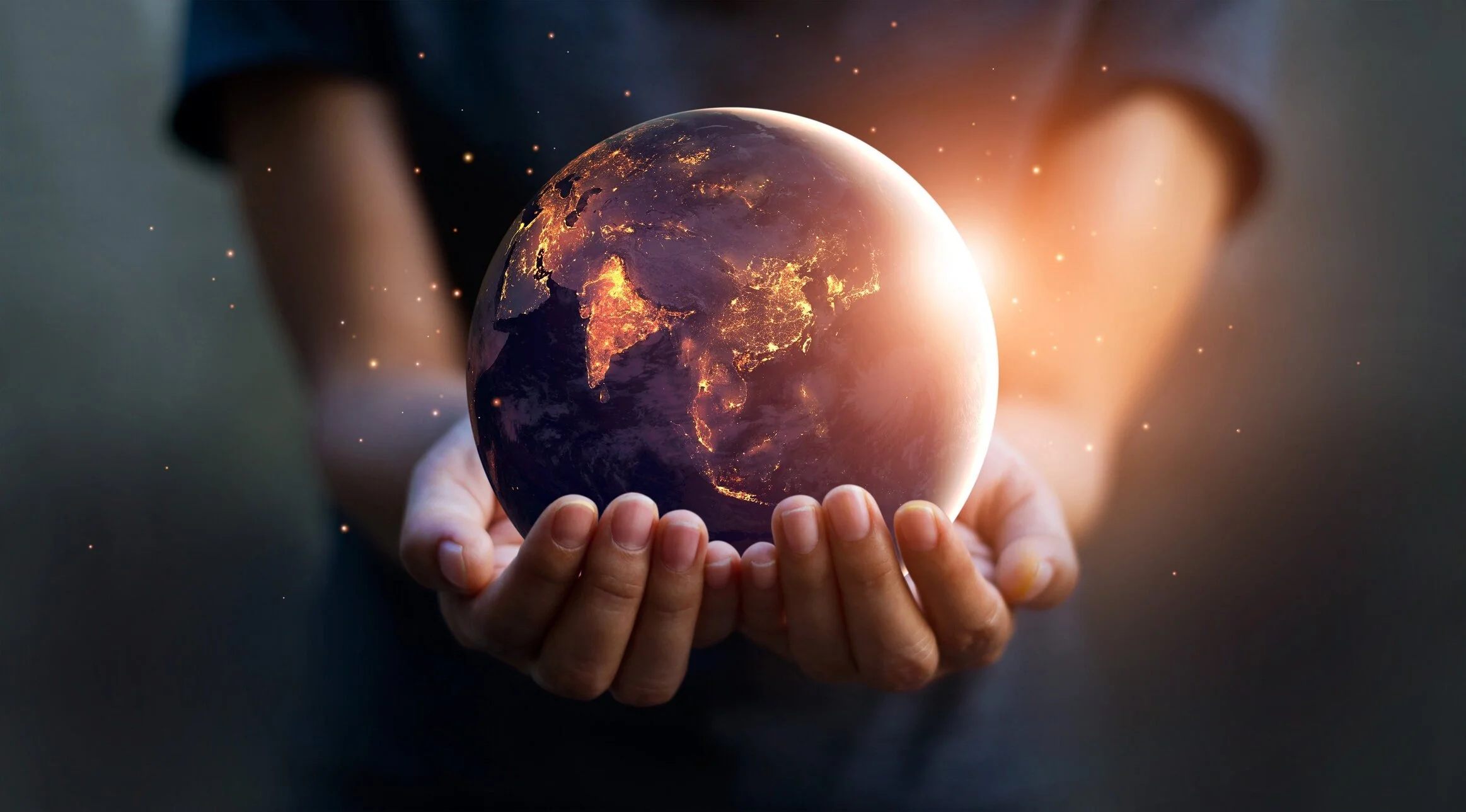
A toast to Mother Earth:

Thank you for providing us trees that give us shade, beauty, oxygen, and removing carbon dioxide to keep our planet healthy.

Thank you for the oxygen we breathe.

Thank you for providing us with food that grows naturally and is so plentiful and delicious.

Thank you for giving us landscapes so beautiful, I can hardly believe the beauty I see.

Thank you for all beings on this planet as we all have a purpose for being here and are interconnected, as the bees who pollinate our food and elephants who are natural gardeners of the forest create more plant life that provides us oxygen.

Thank you for the water you provide which we rely on to live.

Thank you for inspiring us by your natural beauty.

Thank you for providing conditions for us to live and enjoy.

Thank you for being!


Photo by Amy Shamblen on Unsplash

Let's clean up the trash and do some good

Did you know some trash items take up to 600 years to decompose????

A lot of this trash is ending up in our oceans and waterways killing our wildlife and harming our environment.

But we can help clean up the trash this Earth Day and always by providing information to researchers to create informed solutions to our global trash issue by using the Clean Swell App by @oceanconservancy.  

All you have to do is download the app and no matter where you are, you can record your trash pick-up which then instantaneously uploads to Ocean Conservancy’s global ocean trash database.

To learn more, go to www.oceanconservancy.org and click on the Clean Swell App.

Let’s do some good for the planet :))))

Photo courtesy of Rafeed Hussain, Ocean Conservancy Clean-Up

"Nature Rights" can help stabilize wildlife populations and ecosystems

What if we lived in a world where “Earth rights” or “nature rights” as the resources of nature would not be used, owned, or degraded including wildlife?  

Recently, Ecuador has become the first country in the world to give rights to individual wildlife. 

This decision comes after a woolly monkey, named Estrellita was taken out of the wild at one month old to live with Ana Beatriz Burbano Proaño 

and her family.   After 18 years of living with this family, the monkey was seized by local authorities to live in a zoo.  Within a month of living in the zoo, Estrellita died from cardiac arrest. 

Prior to her death, the family filed a case to get Estrellita back, stating the monkey was probably experiencing distress from being separated from the family.  The court ruled that both the authorities and the family violated Estrellita’s rights stating;

"The domestication and humanization of wild animals are phenomena that have a great impact on the maintenance of ecosystems and the balance of nature, as they cause the progressive decline of animal populations." 

This ruling to include “nature rights” within a country’s constitutions such as Ecuador is a beacon of light for other countries to step up.  We are seeing the sixth mass extinction we are currently experiencing and climate change are interdependent.  As we see wildlife’s right to exist, especially keystone species that support ecosystems which we rely on for the health of the planet, we realize our interconnectedness to all beings and nature.  Once that realization happens, we can actually make real change for the planet and ourselves.  

Reference:

https://www.sciencealert.com/the-first-country-in-the-world-has-given-legal-rights-to-individual-wild-animals/amp

“When Elephants Go, So Do Trees”

We are interconnected with nature in so many countless ways that benefits us.  Trees for example, provide us with oxygen, prevent soil erosion, and absorb up to 7.6 billion metric tons of carbon dioxide per year.  But as deforestation occurs rampantly around the globe, these benefits are becoming less and less.  

Elephants, however are known as the ‘Gardeners of the forest’ and actually ensure the survival of trees as they disperse seeds from trees they forage from.  But as wild elephant populations continue to dwindle due to the illegal ivory trade and elephants taken from the wild to be used in the tourism industry, the biodiversity of ecosystems begin to crash, resulting in tree species unable to thrive.  

In the article; ‘When Elephants Go, So Do Trees’, it explains our interdependence with nature and just how valuable elephants are in the ecosystem.  Without the presence of keystone species such as the elephant, nature and the benefits it provides for us rapidly ceases to exist.  

To read this article, copy and paste the link below;

https://www.onegreenplanet.org/animalsandnature/when-elephants-go-extinct-they-will-take-the-trees-with-them/

Video of importance of forest elephants

“When one tugs at a single thing in nature, he finds it attached to the rest of the world.”  John Muir

Photo by Rob Hampson on Unsplash


RSS Block
Select a Blog Page to create an RSS feed link. Learn more

Mangroves are a nature-based solution for climate change

The World Wildlife Fund recently wrote an article about the importance of mangroves being a nature-based solution to fight against climate change.  Nature-based solutions are reference to the abilities of nature itself to mitigate the impact of climate change.  

Mangroves are trees with very deep roots growing along coastlines in tropical and subtropical regions.  Because of their deep root systems, they have the ability to protect coastline degradation against extreme weather like hurricanes and water rise.  In addition, due to the soil they live in, they also have the capability to capture and store four times more carbon than other tropical rainforests, making them a champion to fight against climate change.  

Mangroves also support marine young marine life such as sharks, grouper, and parrotfish who live in and around the root systems of the trees until they are big enough to swim out to coral reefs.  

World Wildlife Fund in partnership with the Bezos Earth Fund is helping to restore and strengthen the management of 2.24 million acres of mangroves which will protect 2 billion tons of carbon stores in countries like Mexico, Madagascar, Fiji, and Columbia.

To learn more, copy and paste the link below;

https://www.worldwildlife.org/stories/mangroves-as-a-solution-to-the-climate-crisis

*Photos courtesy of Discovery.com and istock.com


RSS Block
Select a Blog Page to create an RSS feed link. Learn more

Great Pacific Garbage Patch

The Great Pacific Garbage Patch is a large collection of plastic and debris in the Pacific.  It is comprised of two garbage patches; one near Japan called the Western Garbage Patch and the other is the Eastern Garbage Patch located between Hawaii and California.  

These patches of debris are linked by the North Pacific Subtropical Convergence Zone where the warm water from the south Pacific meets the Arctic cool water.  This convergence acts as a highway that keeps moving the debris from one patch to another.  

This patch was first discovered in 1997.  But the build-up of garbage started in the 1980’s.  It is now approximately 1.6 million square kilometers.  What is worse is about 70% of the debris sinks to the bottom of the ocean.

According to the World Wildlife Fund, 8 million tons of plastic ends up in our oceans. As these patches continue to grow, marine life are mistaking the plastic as food, which can lacerate their organs, and the marine life get tangled in the garbage.  These patches also accelerate climate change because heat can cause the plastics to burn off carbon emissions.   

In August, 2021, a non-profit called Ocean Cleanup deployed a large-scale cleaning system to remove the debris.  Ocean Cleanup returned in December of 2021 to continue to remove more garbage.  

This technology is helping to lessen the mess we made but it cannot be our only solution to reducing the human-made waste that ends up in waterways, as some of it makes its way to these garbage patches.  

Things we can do:

·     If you live near an ocean, volunteer to clean the shoreline to help remove debris on shores. 

·     If you don't live near an ocean, you can help clean up parks or local neighborhoods, as trash in those areas can eventually end up in marine environments. 

·     Donate to different organizations that support removing the trash, such as Ocean Conservancyand Oceana.

References:

https://www.nationalgeographic.org/encyclopedia/great-pacific-garbage-patch/

https://www.cnet.com/how-to/the-great-pacific-garbage-patch-is-getting-worse-heres-whats-happening/

https://www.wwf.org.au/news/blogs/plastic-waste-and-climate-change-whats-the-connection#gs.erpmdl


Images courtesy of Plastic Atlas


RSS Block
Select a Blog Page to create an RSS feed link. Learn more

Keeping half of the Earth wild helps sustains life

According to American biologist, Edward O. Wilson, he proposes in his book Half-Earth that by committing half of the planet to nature, we can hope to save the immensity of life-forms that comprise it.  

He states: “At one-half and above, life on Earth enters the safe zone.  Within half, existing calculations from existing ecosystems indicate that more than 80 percent of the species would be stabilized.”  

Saving our wild spaces impacts so many facets of life on earth.  By preserving these wild spaces, biodiversity is maintained, which is like life-support for life on earth.  

The plant life of wild spaces actually give back to the planet by actions like absorbing and storing carbon, releasing oxygen for the planet, and seed dispersal for new plant life that continues this process.  These actions help to regulate the temperature of the planet.  These wild spaces also encompass watersheds that help to drain freshwater into water outlets like rivers and lakes that provide us drinking water.  

With regards to wildlife, marine life like whales and sharks help to feed the phytoplankton on the ocean surface that act like plants that absorb carbon dioxide and provide us with oxygen.  In effect, whales and sharks help to provide us with 50-80% of the oxygen we breathe. 

The same goes for rhinos and elephants who disperse seeds they eat from shrubs and other plants that will grow elsewhere providing us with oxygen and also absorb carbon from the atmosphere.  

Every ounce of nature has a purpose and ultimately helps keep our planet healthy. 

We just have to shift our view to a wider-angle lens to see the larger perspective of what is really happening here.  We are just one of 8.7 million species sharing the planet.   This is home for all of us.  By helping to save wild spaces, we are helping ourselves and each other.

References:

1.    Wilson, E.O., 2016, Half-Earth, Liveright Publishing Corporation, New York 

2.   https://natureneedshalf.org/why-50/

Photo by Sebastian Unrau on Unsplash

RSS Block
Select a Blog Page to create an RSS feed link. Learn more

How climate change is affecting water availability

The United Nations stated; “Water is the primary medium through which we will feel the effects of climate change.”  

A rise in global temperatures has been causing an increase in larger amounts of water evaporation which leads to more frequent, intense, and heavy rains as seen when Typhoon Rai, one of the strongest in history to hit the Philippines in December of 2021.  

Climate scientists predict these intense rains will cause increased flooding.  This excess water or water run-off will pick up contaminants like fertilizer and eventually will end up in larger bodies of water like lakes and oceans, resulting in increased water pollution and limiting water access for us and ecosystems.

As fertilizers pollute our lakes and oceans, they cause algae growth.  These algal blooms block sunlight for underwater life and decrease oxygen levels within the water.  These algal blooms are toxic and can kill off fish and other marine life, which are also resistant to the purification process, making tap water unfit to drink. 

As global temperatures increase, freshwater glaciers begin to melt and runoff into the oceans which causes the sea levels to rise.  With this rise in sea level, more saltwater contaminates aquifers which are bodies of rock that hold or contain freshwater.  In places where droughts occur consistently and freshwater is lacking, a process called desalination is used to remove the salt from the saltwater.  Unfortunately, this is a very high-energy and costly process in order to produce fresh water.  Places like the Middle East, the Caribbean, and North Africa use this process out of necessity.  

Even snowmelt is used as a freshwater source and held in reservoirs.  As snow fall begins to decline in many areas, farmers may not have this reserve of water to irrigate crops. 

Water scarcity is the result of a rise in global temperatures.  The main objective is to focus on what we can do now to address and approach this issue.  

As consumers, we can help by:

·      Looking to buy local produce which saves on the energy used to transport produce, thereby reducing carbon emissions that result in increased global temperatures

·      If you have a dishwasher, run a full load so you are not running the dishwasher all the time and use an energy saving setting if available

·      When using a washing machine, using cold or warm water is more energy efficient than using hot water and running a fuller load than washing many smaller loads will also save water.  If possible, upgrade to an energy efficient washing machine.  

·      Turning off the tap when brushing your teeth will save on water. 

·      If looking to purchase a car, check for fuel efficiency 

But overall, some of the practices that would truly benefit us are:

·      If fossil fuel dependent industries would make the switch to using cleaner renewable energy sources

·      Finding ways to recycle wastewater

·      Improve agricultural irrigation

·      Improve energy consumption of desalination plants

·      Create new water conservation technologies 

·      The auto industry creating more fuel-efficient cars


References:

https://www.unwater.org/water-facts/climate-change/

https://www.nationalgeographic.org/article/how-climate-change-impacts-water-access/

https://www.nationalgeographic.org/encyclopedia/aquifers/

https://www.circleofblue.org/2010/world/experts-name-the-top-19-solutions-to-the-global-freshwater-crisis/ 

Photo by United States Geological Survey on Unsplash

Algal blooms on Milford Lake, Kansas, United States

RSS Block
Select a Blog Page to create an RSS feed link. Learn more

How I became Wild For Change

For as long as I can remember, I always LOVED animals.  It was as natural for me to be friends with a dog, cat, or bird as having human friends.  There always seemed to be kinship, a recognition of each other’s hearts when I was around animals.  

As I grew up, I wanted to work with animals in some capacity.  But I saw becoming a vet as my only option and knew I would have a difficult time seeing an animal sick or dying.  

When I entered college, I decided to become a physical therapist.  I dedicated my whole heart and soul into helping others for over a decade. 

During my career, I never stopped helping animals. I would write letters to decision makers and sign petitions to help raise awareness of animal welfare issues.  

In 2011, I visited the Performing Animals Welfare Society in California that changed the course of my life. I was able to meet animals that were rescued from performing animal trades.  Seeing these animals living freely was a sight to behold.  One elephant in particular that stole my heart was Nicolas.  Nicolas was forced as a baby to ride a tricycle in a circus and seeing that image in my mind was so egregious, so callus, that at that moment, I knew I wanted to do more to be a voice for animals.  

The photo of my hand in Nicolas’ paw print was a symbol of my pact with him and all animals that I was saying yes to be a voice for the voiceless.   

Three years later, I resigned as a physical therapist to set on my path for helping animals.  One day I read an article about a woman in Vermont who was working with state legislation to ban the sale and trade of ivory.  I was able to contact her and said I wanted to help ban the sale and trade of ivory in Illinois.   She introduced me to the good people at the Humane Society of the United States and Tusk Task Force.  With their help, we fought the battle to ban ivory from being sold and traded in Illinois. 

In 2018, I decided to start Wild For Change to advocate for all animal welfare and the conservation of nature because what animals and nature provides for us is invaluable and our interconnection with all of nature is necessary for us to thrive.  It has been an absolute blessing for me to be on this path. 

Ending Wild Animal Circuses

What do you feel when you see this photo?

When I look at this photo, it makes me want to cry.  Seeing wild animals being forced to perform tricks to entertain US, makes my heart scream.  I can think of a million and one ways to spend my time than paying to see an animal forced to do something so foreign and unnatural.  

I feel fortunate to have been part of advocating for Illinois to become the first state in the U.S. to ban the use of elephants in traveling shows in 2017.   

Unfortunately, there are still wild animal exhibits that travel through the U.S. with primates, big cats, and bears.  These animals are meant to be wild but are instead subjected to abusive training, constant confinement, and neglect.  

Not only are these exhibits exemplary of egregious abuse of animals, but are a public safety threat, display a disregard to animal conservation, and are becoming less and less popular.  Many of these traveling shows have histories of federal Animal Welfare Act violations and dangerous incidents. 

If you see a wild animal exhibit, come through your town, call your state legislators and tell them these traveling shows are in no way benefitting the captive animals and are a major public safety threat.  

To find your U.S. state legislators, go to www.openstates.org

Photo courtesy of Alamy 


Amazon Rainforests are imperiled and we need them

Did you know rainforests are the earth’s oldest living ecosystems, with some reaching 70 million years old? They are like the great-great grandparents of the earth.  

Rainforest ecosystems are home to more than half of the world’s plant and animal species even though they cover roughly only 6% of the earth’s surface.  

Rainforests not only support the plant and animal species living there, they also support us.   Rainforests produce about 20% of the world’s oxygen and store a massive amount of carbon dioxide which helps to stabilize the earth’s climate. 

But the rainforests in the Amazon have been taking a massive blow in the last several decades.  According to the Yale School of Forestry and Environmental Studies, 80% of the Amazon rainforests are being destroyed for cattle ranching in Brazil.  

Edward O. Wilson, American biologist, and author, stated in his book Half-Earth; “A 2008 mathematical model by a team of botanists predicted that between 37 and 50 percent of rare tree species in the Brazilian Amazon rain forest, “rare” defined as having populations of fewer than ten thousand individuals, will suffer early extinction, caused by contemporary road building, logging, mining, and conversion of land to agriculture.”

According to the UN Food and Agriculture Organization, beef production gives rise to more greenhouse gases than the transportation industry. This includes roadways, airways, railways, and ports!  I have a hard time wrapping my head around that there is more cattle production than all the cars on the road, than all the flights that occur around the world on a daily basis?

Even though these rainforests sit on small parcels of land, they pack a punch to keep our planet healthy.  These rainforests are vital to all of our survival. 


References:

1.    https://www.onegreenplanet.org/animalsandnature/beef-production-is-killing-the-amazon-rainforest/

2.   https://www.nationalgeographic.org/encyclopedia/rain-forest/

3.   https://www.washingtonpost.com/business/2019/08/27/how-beef-demand-is-accelerating-amazons-deforestation-climate-peril/

4.   Wilson, Edward O. Half-Earth. New York, Liveright Publishing Corporation, 2016

Image courtesy of @Greenpeace /Daniel Beltra

Throughout world history, animals have been tested for biomedical research.  Currently, animals such as rabbits, guinea pigs, rats and mice are used and exploited for testing beauty products.  For example, rabbits’ skin will be shaved to drip chemicals on or the chemicals are dripped into their eyes to test for a reaction to determine if the chemical can be used in a product for human use.  

Vicki Katrinak, director of Animal Research and Testing for the @humanesociety reports; “With a growing number of non-animal test methods available, there is no ethical justification to continue harming animals for the sake of shampoo, mascara, or aftershave.” 

And as more awareness is shining a spotlight on ending animal testing, there is also a growing number of product lines that are vegan (contains no animal by-products) and cruelty-free (not tested on animals).  To find a list of vegan and cruelty-free products, please click here.

As momentum continues, a growing number of U.S. states are banning the sale of animal tested cosmetics and recently, New Jersey became the 8th state in the U.S. to pass this law!

I want to give a huge THANK YOU to Governor Murphy, and State Senator Joseph Lagana and State Assemblyman Anthony Verrelli, who were the primary sponsors of this important legislation.

Image courtesy of www.ethicalpixie.com


Betty White, was an iconic actor whose career spanned nearly seven decades.  She was truly one of America’s sweethearts, loved by all, and had a knack to make anyone laugh.  

Beyond her gift to bring a smile to anyone’s face, she had a love for animals and devoted her entire life to support animal welfare.  Throughout her life, she provided support for local animal shelters, was a monumental voice for providing animals in the L.A. Zoo with enriched habitats, and helped fund a wildlife rescue after the Deepwater Horizon oil spill in 2010 that impacted marine life in the Gulf of Mexico.  These acts of kindness are just to name a few of her contributions.  

She continuously supported animal welfare whether for dogs or dolphins throughout her life and because of her champion spirit for animals, she has always been a role model to me.  

If you are a fan of Betty White, an animal lover, or both, please consider donating to one of your favorite animal organizations in her name. 

Wolves; An iconic species under attack

Wolves are an iconic keystone species that have been an inextricable part of the North American landscape.  Two million wolves once roamed North America freely but as settlers came to the new world, the wolf population became threatened and by the 1940’s, they were extirpated.  In the 1960’s, the dwindling wolf population became federally protected under the Endangered Species Act.  Currently, the North American wolf population is estimated at 18,000.  

In the last thirty years, the wolf population have slowly recovered but their habitat range is less than 10% of their historic range.  Wolves have been under attack by both state and the U.S. federal wildlife agencies for many years.  In 2020, the previous U.S. administration removed the gray wolf from federal protection. 

Many states allow for wolves to be hunted, trapped, and poisoned.  Currently the state of Idaho is planning to wipe out 90% of its wolf population.  Some would argue that there isn’t enough space for the wolf population, even though it has been found there is at least 530,000 square miles of excellent wolf habitat in the lower 48 states.

Across the world, each continent has an iconic species that is able to tell a story about that region long before humans came into existence and for North America, one of those species is the wolf.  It is a part of the continent’s geographical, ecological, and evolutionary history.  It tells a story that no other species can tell.  But yet, here we are standing in the midst of their existence being destroyed.  

To advocate and take action for wolves, please copy and paste this link into your browser;

https://www.saveourwolves.org

References:

1.    https://www.saveourwolves.org/on-social-media/

2.   https://www.californiawolfcenter.org

3.   https://speakforwolves.org

4.   https://www.biologicaldiversity.org/campaigns/gray_wolves/

Photo by Thomas Bonometti on Unsplash

COP26 - There is no planet B

The United Nations Climate Change Conference (COP26 – Council of Parties 26th annual summit) recently convened in Glasgow, Scotland.  The purpose of this summit is to reach agreement on how to tackle climate change.  

In reference to this climate summit, global leaders met in Paris in 2015 to reach an agreement to hold the increase in global temperatures to well below 2 degrees Celsius above pre-industrial levels but preferably to 1.5 degrees Celsius.  

However, scientific reports from climateactiontracker.org state that with current global policies, there is a projected 2.7-degree Celsius rise in temperature from pre-industrial levels by the turn of the next century.  The main contributors to global emissions that are responsible for the rise in temperature are gas and coal. 

Climate change is becoming more of a threat as countries are experiencing loss and damage from flooding, droughts, and heat waves.  According to the U.K.’s. Met Office, one billion people will endure extreme stress if the global temperature continues to increase by 2 degrees Celsius. 

Bill Hare, CEO of Climate Analytics stated;

“It’s all very well for leaders to claim they have a net zero target, but if they have no plans as to how to get there, and their 2030 targets are as low as so many of them are, then frankly, these net zero targets are just lip service to real climate action.”

Lip service is the last thing this world needs.  Whether we realize it or not, we are all interconnected.  The pandemic is the most obvious example of our interconnection.  All of our lives have been affected by it and the outcome of climate change will be no different.  


References:

1. https://www.carbonbrief.org/cop26-key-outcomes-agreed-at-the-un-climate-talks-in-glasgow

2. https://climateactiontracker.org/global/temperatures/

3.  https://www.forbes.com/sites/teakvetenadze/2021/11/09/researchers-predict-dire-24-degree-temperature-rise-even-with-climate-pledges/?sh=724943ea7afb 

Photo by Li-An Lim on Unsplash


Happy World Animal Day 2021!


“We have more to learn from animals, than animals have to learn from us.”

Anthony Douglas Williams 

Animals bestow us with many gifts.

 Animals offer us a mirror that reflects our truest self, which is we are a part of nature.  All living beings collectively make up this larger framework of life.  

Animals provide the blueprint to help keep our ecosystems balanced and intact.  

Animals also make this world richer, grander, more meaningful and beautiful just with their presence.  

When we stop and pause, we can see these gifts more clearly.  

Helping to save their lives is helping to make our world a better place for all of us.   

The Nature Watch Foundation sponsors the annual World Animal Day Grant which funds amazing projects to improve animal welfare around the world.  You can learn more about these projects on their website at www.naturewarch.org


Photo by Hu Chen on Unsplash

Do you give a crap about where your toilet paper comes from?

I just learned that major toilet paper brands like Charmin, Cottonelle, Angel Soft, Quilted Northern, and Kirkland make their toilet paper from virgin forest fiber.  This means that their toilet paper comes entirely from pristine forests and not even partly from post-consumer recycled paper.  But why should we give a crap about it? 

These manufacturers get their paper product from boreal forests of Canada.  Boreal forests make up 77% of Canada’s forests and are found in the boreal zone which is just below the arctic tundra to southern Canada. These forests emerged after the last Ice Age, approximately 12,000 years ago and are one of the most ecologically important forests in the world.  The boreal forests lock away nearly twice as much carbon as is contained in the world’s recoverable oil reserves.  To boot, threatened and endangered species like caribou and grizzly bear live in these woodlands and nearly three million birds migrate to this area every year.  But nearly one million acres of Canadian boreal are cut away each year for logging which means the size of a small city block are roughly clearcut from this area every MINUTE.  

Jennifer Skene, attorney with NRDC’s Canada Project stated: “With every roll of their unsustainable toilet paper, companies are pushing the world closer to climate catastrophe. That’s because climate change isn’t just about smokestacks and tail pipes, or oil wells and coal mines. It’s also driven by cutting down irreplaceable climate-critical forests like the Canadian boreal for something as short-lived as a flush.” 

Fortunately, some companies do give a crap about sustainability and where they source their toilet paper.  These are the companies who get an “A” for making the most sustainable toilet paper:

·      Who Gives a Crap

·      365 Bath Tissue

·      Ever Spring

·      Seventh Generation

·      Trader Joes Bath Tissue (TJ’s Super Soft brand got a C grade) 

Even though I do not live near the Canadian boreal forests, it doesn’t mean my consumer choices do not affect this region and despite the distance between myself and those forests, I still receive the benefits of their presence; cleaner air and a healthier planet.  If you give a crap about the trees, please don’t squeeze or buy the Charmin.  

Photo by Denny Müller on Unsplash 

References:

1.    https://www.nrdc.org/media/2020/200618-20

2.   https://www.nrcan.gc.ca/our-natural-resources/forests-forestry/sustainable-forest-management/boreal-forest/8-facts-about-canadas-boreal-forest/17394

3.   https://www.treehugger.com/fascinating-facts-about-the-boreal-forest-4858782

The Environmental Impact of Fast Fashion

I love clothes.  Period.  Buying a cute top can lift my mood.  But I am realizing that my impulse buy on that cute top could be causing more harm than good.  

Fast fashion is a global trend that is defined as readily available and inexpensive clothing.  It is described as “fast” as it shows how quickly a clothing brand can move clothing from the catwalk to a store and keep up with the growing demand of new fashion. 

 According to the article The global environmental injustice of fast fashion, nearly 80 billion pieces of clothing are purchased each year. The United States consumes most of the clothing purchased globally.  85% of clothes purchased in the U.S., which translates to nearly 3.8 billion pounds, ends up in landfills each year. 

In 1960, 95% of clothing purchased in the United States was made in the United States.  Today most of the clothing is made in countries such as Bangladesh and China.

In 2014, the average person purchased 60% more clothing than in 2000.

90% of the clothing purchased in the United States is made from cotton or polyester.  Both of which have environmental impacts.  Polyester is a synthetic fiber made from oil and cotton requires a lot of water and pesticides to grow.  Speaking of water, it takes 3,000 gallons of water to produce one t-shirt!

Not only is there a lot of water that goes to waste to create clothing, but the waste water from dyeing clothes gets into water ways and pollutes the local water systems. 

It is reported by GASP (Group Against Smog and Pollution) the fast fashion industry is responsible for about 10% of global CO2 emissions. That is some food for thought next time I’m thinking about buying clothes.

Now since the world has been trending to buy new clothes at a high rate, what happens to the old clothes we no longer want to wear?  Donate the old to bring in the new?  

According to thenation.com, over 15 million garments go through the largest secondhand market in Ghana each week.  Most of the clothes come from the United States, United Kingdom, and Canada.  Half of what is bought in this secondhand market is thrown away.  Clothes end up in the streets, on beaches, and in dumpsites.  Some of the clothing winds up in the oceans, wrapping around itself and other waste causing tentacles up to 25 feet long.   These tentacles wrap around boats and harm marine life.   

Liz Ricketts, cofounder of the OR Foundation, a charity that advocates for alternatives to the current wasteful fashion model stated; ‘We are seeing millions of garments go into the ocean every day.” 

The plastic pollution that ends up in the oceans is already doing so much harm and shouldn’t be there in the first place.  Now we have clothes polluting the oceans, just adding more insult to injury. 

What about the safety and well-being of the people working in the factories that make the clothing?  90% of the clothing produced is made in low to middle income countries.  Due to a lack of governmental infrastructure in these countries, the occupational and safety standards needed for the workers are often not enforced. There are ventilation hazards and occupational risks associated with clothing production.  

So, where do we go from here, now that we know what the global effects are of fast fashion?

From what I researched there are some ways to really help offset the fast fashion trend;

First, using sustainable fibers such as Lyocell which is made from the cellulose of bamboo will help lessen the impact fast fashion has played on the environment.    

Second, adopting internationally recognized criteria for producing eco-friendly clothing will encourage clothing lines to create sustainable production of clothes as well as limiting the amount of clothing produced to appeal for the high demand of new and fast fashion.

Third, we the consumers have a part to play!  We can buy better pieces of clothing that lasts longer, shop at second hand stores, and repair the clothes we already own.  Another solution is to buy from retailers that promote transparency of their supply chain and produce a finite amount of clothes so excess textiles and clothes do not go to waste or end up on a cargo flight to a secondhand store across the world only to end up on the street, in landfills, or the oceans.  

Personally, since I have learned about fast fashion, I am more aware of my impulse buys and think twice before I buy anything.  Now I think to myself; “How long will I wear this top if I buy it?”  I am paying more attention to find retailers that produce and sell only a small amount of clothing and a bonus if the clothes are made in the United States.  It has been a huge eye opener for me and now I feel like I found another way to help reduce my impact on the environment. 

Photo by Francois Le Nguyen on Unsplash

References

1.    Niinimäki, K., Peters, G., Dahlbo, H. et al. The environmental price of fast fashion. Nat Rev Earth Environ 1, 189–200 (2020). https://doi.org/10.1038/s43017-020-0039-9

2.   Bick, R., Halsey, E. & Ekenga, C.C. The global environmental injustice of fast fashion.Environ Health 17, 92 (2018). https://doi.org/10.1186/s12940-018-0433-7

3.   https://gasp-pgh.org/2020/07/28/clothes-climate-change-how-a-fashion-choice-change-could-lead-to-better-air-quality/

4.   https://www.commonobjective.co/article/the-issues-waste
Why being a bird nerd is good for you

I grew up in the city with not a lot of exposure to wildlife.  Sure, we had little sparrows that would sit in our tree and chit chat with each other, but I really didn’t pay much attention to what they had to say. 

When I got married, my husband and I moved into the suburbs near a forest preserve.  I was never a morning person but waking up to the early call of the robin which was soon followed by other birds, actually put a smile on my face as I started to wake up.  It sounded like an orchestra in the morning right outside my window.  

Just by being outside, I began to learn each bird call and since they hung around my house a lot, I started feeding them.  I learned the cardinals like sunflower seeds, the blue jays and woodpeckers liked peanuts, the finches like milk thistle, and the hummingbirds like sugar water.  Soon in the mornings, the blue jays would sit on my deck asking for peanuts.  The hummingbirds would look in my window wondering when their sugar water was going to be ready.  The sparrows began sitting in the bush outside my door asking each other when breakfast was being served.  I kid you not.  What I began to notice is the birds noticed me!  

Listening to the birds and having a relationship with them gave me a sense of joy and contentment.  It’s an instant pick me up.  I soon felt immersed in nature and began to see my connection to something bigger.  My perspective on life has changed.  I can clearly see nature’s calming effect on me and how there is a reciprocal relationship between us and nature.  Nature’s intention is to not only help us feel good, it also helps us understand we are all interconnected.  

But don’t just take my word for it. Here is an article about how being in nature and becoming a bird nerd could be the best medicine for you; 

https://www.audubon.org/magazine/winter-2019/birding-benefits-how-nature-improves-our-mental

Getting into the green spaces and places is medicine for the soul.  If you’re feeling down and need a lift, get outside and let your inner bird nerd fly!

Photo courtesy of Mark Olsen on Unsplash

How Conserv Congo is fighting against wildlife trafficking in the DRC

In the What on Earth? podcast, Adams Cassinga, founder of Conserv Congo discusses the affects of wildlife poaching in the DRC and the changes needed to reduce this threat.

The shy and harmless Pangolin is one of the species under threat in the DRC. Did you know pangolins are the most trafficked animal in the world? They are wanted for their scales which are comprised of the same material as our nails; keratin. Similar to rhino horn, the scales are used in traditional Chinese medicine for things like arthritis, but do not have any medicinal value.

There are eight species of pangolins, four of which are found in Asia and four are found in Africa. All of the eight species populations are threatened due to illegal trafficking. For many years the Asian pangolins were the most heavily trafficked but since their population is in such decline, the African pangolin is now a heavy target by poachers and wildlife traffickers.

Just recently, two tons of pangolin scales were seized in a DRC airport.

To learn more of what Conserv Congo and other conservationists are doing to fight against wildlife trafficking of endangered species, please listen in to this What on Earth? podcast;

What on Earth? — Africa’s epicentre of pangolin scale and ivory trade — tackling the drivers of wildlife crime

Photo courtesy of Louis Mornaud on Unsplash